

The Greatness of the Small
- Caceres Media

- Dec 5, 2025
- 3 min read
Updated: Dec 6, 2025
Filioque: When Small Insertions Change History
By Fr. Francis Tordilla
In recent weeks, the nation has been stirred by discussions on alleged “insertions” in the national budget — small additions that can carry enormous consequences. Church History, interestingly, has its own parallel. More than a thousand years ago, a brief phrase inserted into a sacred text helped shape one of the greatest divisions in Christianity. The phrase returns to the headlines with Pope Leo XIV’s apostolic letter In unitate fidei (published 23 November 2025) and his ecumenical pilgrimage marking the 1,700th anniversary of the Council of Nicaea.
How a Tiny Addition Became a Turning Point
Filioque is not in the Creed adopted at Nicaea (325) or in the later Constantinopolitan recension (381); its first formal attestation in Western creedal practice appears in the Third Council of Toledo (589) and it later spread through the Latin West, becoming part of Roman liturgical usage only in the medieval period. The insertion emerged as a pastoral and anti-Arian clarification in the Latin Churches, but its unilateral liturgical adoption became a symbol of competing theological emphases and ecclesial authority — one of several factors that fed the Great Schism.
The theology behind the phrase revolves around the “procession” of the Holy Spirit — meaning, in simple terms, how the Spirit receives and shares in the one divine life of the Trinity. The Latin verb procedere thus expresses the internal relationship by which the Spirit is spoken of as coming from the Father and, in Western formulae, “from the Father and the Son.” That nuance underlies centuries of theological debate. The Latin West emphasized the communion of the Father and the Son; the East emphasized the Father as the single source of the Trinity. These differences, initially reconcilable, gradually symbolized deeper misunderstandings and contributed to the Great Schism of 1054.
In unitate fidei: Call To Put Theology at the Service of Unity
Pope Leo XIV published In unitate fidei ahead of his journey to Turkey and the Nicaea commemoration; the letter summons Christians to renew their profession of faith in the Creed and to seek reconciliation rooted in prayer, listening and conversion. The Pope writes directly about old controversies and the need to move forward:
We must therefore leave behind theological controversies that have lost their raison d’être
in order to develop a common understanding and even more, a common prayer to the
Holy Spirit, so that he may gather us all together in one faith and one love (No. 12).
That paragraph is central: it reframes doctrinal differences as questions to be worked through by patient dialogue and spiritual ecumenism rather than unilateral declarations
A Visit to Nicaea on the Council’s 1700th Anniversary
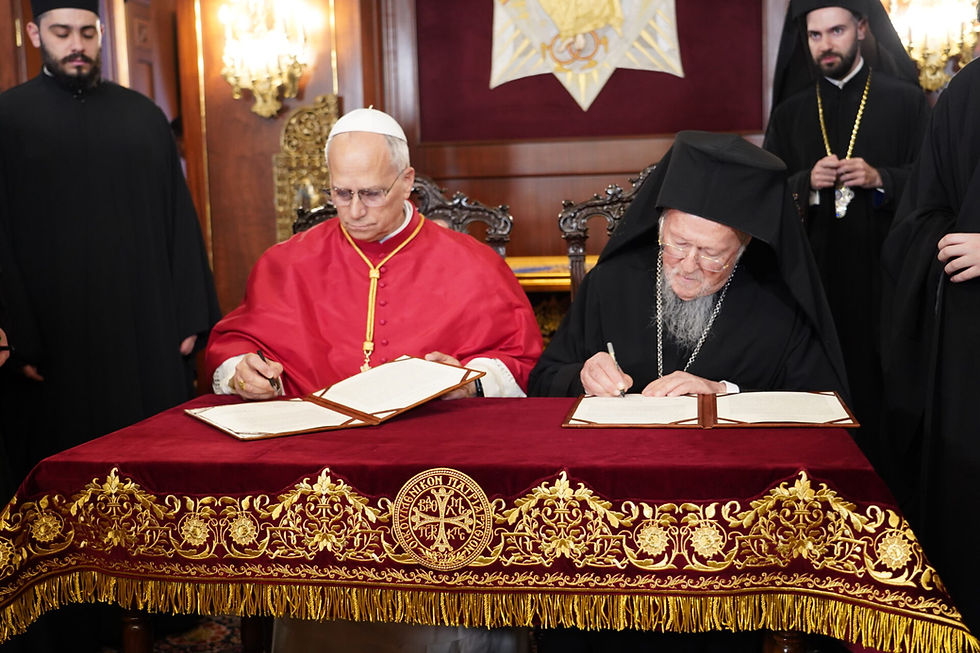
Pope Leo XIV’s journey to Nicaea (now İznik, the site traditionally associated with the Council of Nicaea), where the first ecumenical council met in 325, was therefore more than symbolic. As the Christian world marks 1,700 years since the Council of Nicaea, his visit reminded the Church of the council’s monumental role: defining Christ as “true God from true God,” safeguarding the faith from Arianism, and setting the foundation for all future councils.
The Pope’s visit was an ecumenical gesture — a shared recitation of the Creed and public prayers with Orthodox and other Christian leaders — and as part of broader efforts to emphasize what unites Christians today. Media reports note the pastoral thrust of the trip while also recording varied local reactions.
Greatness in the Small
Here in Caceres, we are reminded that small things matter — in public life and in the life of faith. Just as an inserted phrase once altered the direction of Christian history, small acts of goodwill today — listening, openness, dialogue—can mend wounds once thought permanent.
In a divided world, even a tiny word, spoken with truth and charity, still has the power to heal the Body of Christ.
Comments